

OpenRobOps (ORO), released today by InOrbit.ai, gives robotics developers a production-grade, open-source foundation to escape the build trap, delivering the industry's first ISO 21423 reference implementation and bridging the interoperability gap.
“Working with leading enterprises in manufacturing, logistics and other industries, I have seen firsthand that federated orchestration is essential to scaling automation,” said Florian Pestoni, Founder and CEO of InOrbit.AI, who serves as a member of the ISO working group and representative for ANSI, the US national body. “I’m proud of the collaborative work that led to this landmark international interoperability standard. With OpenRobOps, we are helping take this from theory to market practice.”
At Automate 2026, ten different companies participated in demonstration of multi-vendor orchestration based on InOrbit Space Intelligence, InOrbit.AI‘s flagship product. This was the first public demonstration of ISO 21423. Today’s release of OpenRobOps brings the technology powering those demonstrations directly to the open-source robotics community, empowering OEMs to build standard-compliant fleet managers and reduce friction for their customers.
This key contribution to the open source robotics community mirrors the introduction of the Robot Operating System (ROS), which acted as a catalyst for robotics development, saving researchers and engineers countless hours of rewriting low-level code from scratch and bringing together a strong developer community.
“When we created ROS, our mission was to give roboticists an open ecosystem so they could stop re-inventing basic device drivers,” said Steve Cousins, Executive Director of the Stanford Robotics Center, member of the InOrbit.AI Board of Directors and former CEO of Willow Garage. “OpenRobOps creates the same shift for robot operations and fleet management, while also enabling standards-based interoperability.”
By providing a production-grade operations foundation out of the box, OpenRobOps allows teams to bypass years of backend development. Key features include:
High-throughput telemetry ingest provides a bandwidth-efficient pipeline designed for unreliable networks, ensuring minimal overhead for vitals and hardware diagnostics.
Real-time spatial tracking enables interactive mapping, live camera visualization, and teleoperation with an exclusive robot-locking mechanism for safe manual intervention.
Configuration as Code (CaC) allows teams to manage telemetry sources, metrics, and alert rules seamlessly within Git CI/CD workflows.
Automated incident remediation performs continuous evaluation that detects anomalies, executes autonomous recovery, or escalates issues to human operators.
An edge-to-cloud hybrid architecture offers flexible deployment options to run fully on-premises, air-gapped at the edge, or securely bridged to enterprise clouds.
Native Open-RMF interoperability includes built-in adapters connecting physical and simulated fleets into Open-RMF multi-fleet traffic systems.
OpenRobOps is distributed under the permissive Apache 2.0 license, allowing academic researchers, robotics startups, and commercial enterprises to adapt, embed, and deploy the software without licensing fees.
Docs: openrobops.org/
Repo: github.com/OpenRobOps
Blog post: inorbit.ai/blog/openrobops-release
Press release: prweb.com/releases/inorbitai-releases-openrobops
RobOpsCon 2026 - Oct 22
The premier conference on scaling robot operations.
A day of keynotes, panels, lightning talks, and a hands-on workshop on the hardest problems in physical AI operations.
Now in its third edition, RobOpsCon brings together practitioners to share the lessons learned and network with top industry operators.
Program Themes
Orchestrating Heterogeneous Fleets
Coordinating AMRs, humanoids, cobots, and fixed automation in the same space or across the world. Real-time spatial conflict resolution, task allocation across robots with different capabilities and APIs, and fleet behavior during partial failures in mixed-vendor environments.
Scaling Data Pipelines for Physical AI
Large deployments are becoming the most productive data-generation infrastructure available. Capturing, labeling, and routing high-fidelity telemetry at fleet scale to feed embodied model training and close the sim-to-real gap.
Decentralized Intelligence for Large Fleets
The shift from centralized, deterministic control to on-robot decision-making. Coordination protocols without a single point of failure, safety guarantees, and observability when intelligence is distributed across hundreds of nodes.
Hands-On OpenRobOps Workshop
A working session built around OpenRobOps, InOrbit.AI‘s open-source fleet operations platform. Launch your own instance, connect robots in simulation, and work hands-on with monitoring, alerting, and remote operation. Bring a laptop, or your own robot to connect.
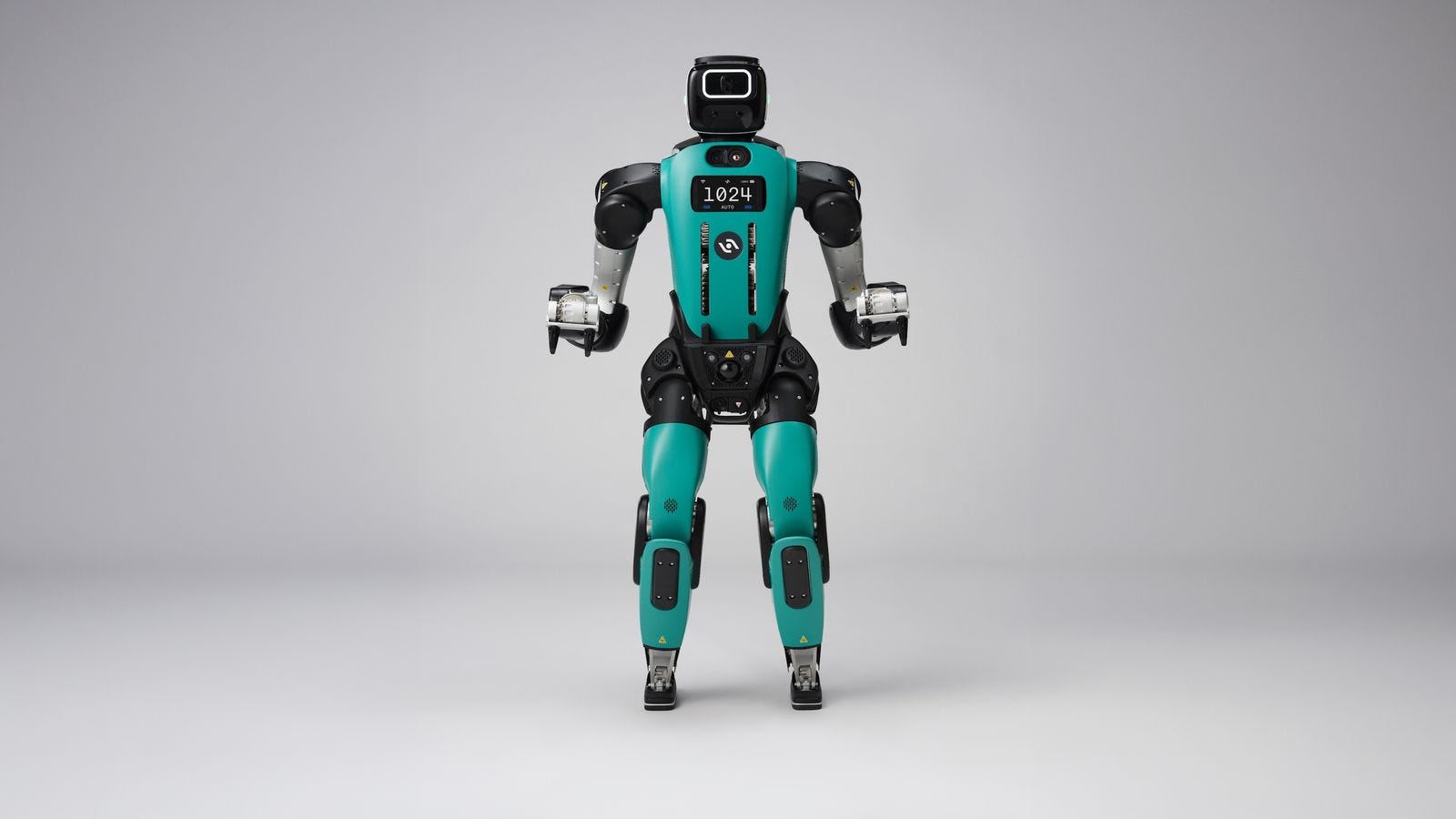
Agility Robotics releases Digit Version 5
Digit 5 is Agility’s first humanoid robot engineered for cooperatively safe work at scale, allowing it to work in close proximity to people without the physical safety barriers required by traditional automation.
“Digit 5 is removing a major barrier to scaling humanoid robots in industrial environments,” said Peggy Johnson, CEO of Agility Robotics. “We built it to the exact requirements our customers gave us after three years of Digit 4 working on their production floors. The market has responded with more than $300 million in multi-year orders and a growing pipeline of customers across manufacturing, warehousing and logistics. That’s value that compounds as Digit’s capabilities expand, backed by real demand.”
A New Architecture for Cooperatively Safe Operation
Safety has been one of the biggest obstacles to scaling humanoid robots in commercial settings. Digit 5’s new safety architecture is designed to reduce dependence on the protective barriers typically used in traditional robotic automation, allowing it to work in close proximity to people. Building on the milestone of becoming the first humanoid to pass an independent field evaluation on a customer production line for industrial safety standards administered by the U.S. Occupational Safety and Health Administration (OSHA), Digit 5 adds:
Safe human detection — Uses proprietary AI algorithms and multiple sensor technologies to continuously monitor for people and take appropriate action by autonomously avoiding, stopping or assuming a seated position.
Safety cues — Uses visual and auditory cues to convey motion intent and alert nearby people to enable their participation in safe operation.
Safe motion control — An independent safety controller oversees Digit’s response to the detection of people within an unsafe distance and instantly triggers the appropriate safety responses.
Agility is expanding Digit 5’s safety architecture by partnering with industry leaders and is the first launch partner for NVIDIA’s Halos for Robotics platform, pairing Agility’s systems with NVIDIA IGX Thor and Halos Core infrastructure.
“Safely operating around people and assets is what moves humanoid robots from pilots to industrial deployments at scale,” said Deepu Talla, vice president of robotics and edge AI at NVIDIA. “Agility’s Digit 5 is building on more than 65,000 hours of real-world operation and pairing its new safety architecture developed on top of NVIDIA IGX Thor and Halos safety framework for Robotics to help humanoids collaborate safely in factories and warehouses.”
Agility is also helping shape the standards that will govern safe robotics, as a project leader and active contributor to the American National Standards Institute’s ANSI/A3 TR R15.108, the technical report under development for dynamically stable industrial mobile robots including humanoids in the U.S. and Canada, and to the International Organization for Standardization’s ISO 25785-1, the first international safety standard for the humanoid category.
Built for Heavier, More Versatile Work
Developed in response to three years of customer feedback, Digit 5 brings substantial hardware upgrades:
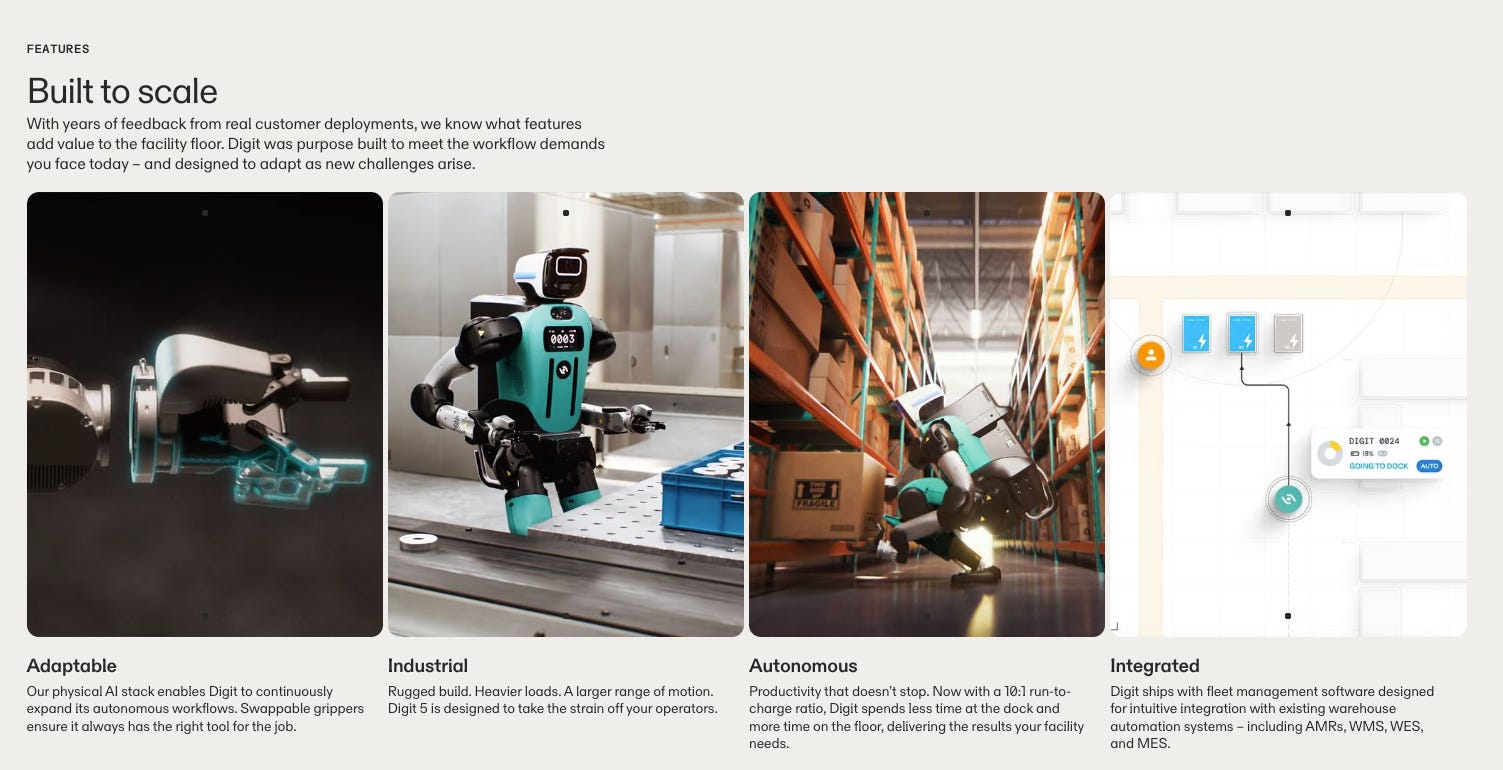
40% more payload — A new leg design engineered to withstand repetitive lifting, powered by proprietary cycloidal actuator technology, lets Digit 5 repeatedly lift up to 50 lb. (22.7 kg) loads, allowing full coverage of single-person lift tasks in OSHA-regulated facilities.
Faster autonomous charging for more time working — A new 90-minute runtime battery system charges in just 9 minutes, giving Digit 5 a 10:1 run-to-charge ratio (up from Digit 4’s 2:1), enabling more than 20 hours of productive work in a 24-hour day.
Swappable end-effectors — A swappable gripper design with ISO-standard mounting flanges allows Digit’s tools to be changed for the job at hand, enabling greater productivity while tackling tasks ranging from tote handling to machine tending.
Higher reach with a human-scale footprint — Digit 5 weighs 284 lb. (129 kg), stands 5’ 11” (1.81 m), and can reach heights of up to 7.2 feet (2.2 m) (up from Digit 4’s 5.5 ft), sized to reach the same shelves and move through the same aisles, doorways and workstations built for people.
Expanding What Digit Can Do
Together these upgrades enable a single Digit 5 robot to take on work that used to require a specialized solution at every stage and remove constraints on scale. Since its first commercial deployments, Digit 4 has largely focused on automating tote-based material handling. Digit 5 will leverage Agility’s proprietary approach to physical AI-based capability training to add more manipulation skills and expand to cover a facility’s full workflow: from depalletizing goods as they arrive, to machine tending, kitting and sequencing, and quality inspection as items move through the facility, and finally palletizing them for shipment as they leave. With Agility’s robot management platform, Digit coordinates each handoff with a facility’s existing AMRs, conveyors and warehouse systems, so material keeps moving between stations. Agility continues to build out the physical AI stack that lets engineers develop new, reliable behaviors for Digit 5 across each new workflow.
Proven in the Field
Digit has the longest tenure among humanoid robots actively working in industrial facilities, with nearly three years of continuous commercial deployment. Digit 4 has logged more than 65,000 hours of operational time and work across numerous customer sites in North America, including GXO, Schaeffler, Amazon, and Toyota Motor Manufacturing Canada.
At GXO’s Flowery Branch facility near Atlanta, Digit 4 reached a cumulative 100,000-tote milestone, maintaining approximately 98% accuracy while on-task.
Customer commitment is translating into orders. As of May 2026, Agility had more than $300 million in multi-year customer orders for Digit 5 subject to satisfaction of certain contractual milestones, and a sales pipeline of prospective customers across manufacturing, warehousing, and logistics, reflecting accelerating demand as customers move from pilot programs to full-scale deployment.
Smarter Fleets with Agility Arc
Digit 5 remains fully integrated with Agility Arc™, Agility’s cloud platform for deploying and managing Digit fleets, which is essential as deployments scale. Arc gives operational visibility into fleet KPIs such as uptime, throughput and Mean Time Between Incidents, and connects with existing Warehouse Management, Warehouse Execution and Manufacturing Execution Systems.
Data Privacy and Security
Agility protects Digit’s platform with end-to-end encryption, strict access controls and localized data processing. Digit utilizes onboard cameras, depth sensors and inertial measurement units to navigate and operate safely, processing sensory data locally and transmitting essential system health and diagnostic information to Agility Arc. Transmitted data is encrypted, segregated by customer, and secured using mTLS and TLS 1.2+ rooted to a private certificate authority, while on-robot storage is encrypted for data at rest.
Designed, Developed and Assembled in the U.S.
Digit is assembled at RoboFabⓇ, Agility’s 70,000-square-foot facility in Salem, Oregon, the first factory purpose-built to assemble humanoid robots at scale. At full capacity, RoboFab is designed to produce up to 10,000 Digit robots per year and employ more than 500 people. Agility’s Pittsburgh, Pennsylvania office leads engineering testing, validation and skills development, and its new Fremont, California facility, opened in July 2026, serves as the company’s hardware and physical AI development hub.
Ready for Global Deployment
In addition to the United States and Canada, for the first time, Agility plans to make Digit available for commercial deployment outside North America, starting with the European Union and United Kingdom. Digit 5 is expected to carry a CE mark and additional regulatory marks to enable market access to the EU, Great Britain and Northern Ireland. Early access to Digit 5 is expected to begin in the first half of 2027, with general availability for manufacturing, warehouse and distribution operators expected by the end of 2027.
https://www.agilityrobotics.com/solutions/digit-5
Robotics Events

Want to host an event or reach the robotics community?
Many companies are reaching out to Silicon Valley Robotics about hosting events, outreach or hiring and we have a great community network, of people looking for work, of investors interested in deal flow and of technologists interested in learning about the latest advances.
Would you be interested in hosting the next Bots, Bevs and Devs? Or something customized specifically for your goals? Reach out here!

More Robotics Events:
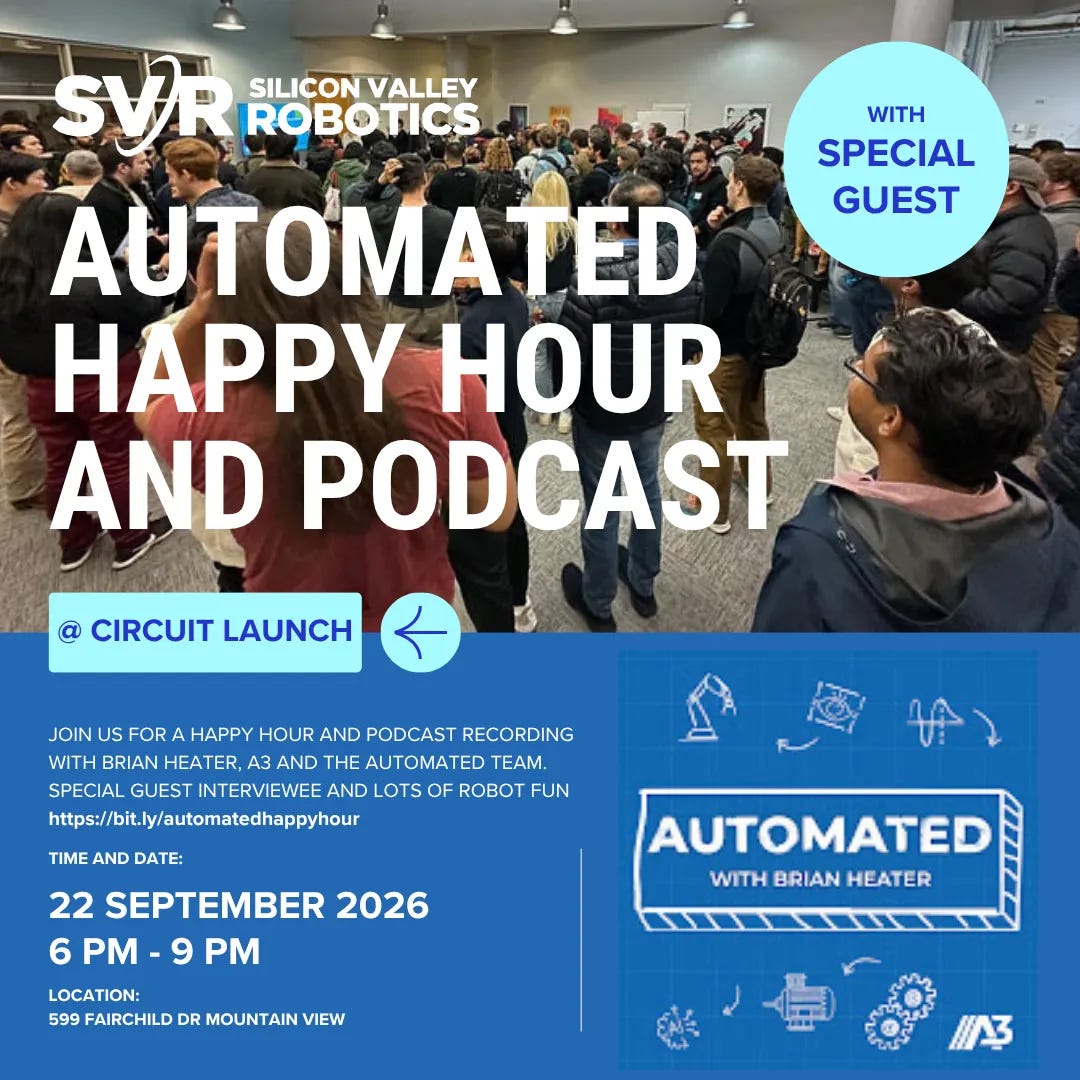
Automated Happy Hour with SVR and A3 - Mountain View - Sep 22 - With Special Guest: Rodney Brooks
ROSCon Global - Toronto - Sep 22 - Sep 24 - TICKET SALES END SOON
IROS 2026 - Pittsburgh - Sep 27 - Oct 1
Bots, Bevs and International Women in Robotics Day - tbd - Oct 7
Long Horizon Physical AI - San Francisco - Oct 20 -21 (use SVR35 discount code)
RobOpsCon - Oct 22
SVR and Intel Robot Developer Workshop - Oct 22
Bots, Bevs & Devs - tbd - Nov4
Bots, Bevs & Devs - tbd - Dec 2
IEEE Humanoids 2026 - Silicon Valley - Dec 6-9
incl SVR Investor Summit and Manufacturing Workshop - Dec 7
The annual IEEE-RAS International Conference on Humanoid Robots is the internationally recognized prime event of the humanoid robotics community. The conference is sponsored by the IEEE Robotics and Automation Society and coordinated by the Technical Committee on Humanoids.
Join the organizing team at Silicon Valley Robotics - bots&beer@svrobo.org


The programme's mention of partial failures caught my eye. I'd find a worked example particularly useful: one vendor's robot loses its connection mid-task, another is waiting for the same space, and an operator takes control. Show the messages, the lock state and what each operator sees. While writing about industrial robots, I struggled to find illustrations that explained the hidden mechanisms; the coordination layer deserves the same sort of cutaway view.
Florian's consistent efforts through the years. Congratulations to Florian.