
2026: Predictions, Competitions and CES
Not all Nvidia! News from Boston Dynamics, Google DeepMind, Agility, Physical Intelligence, meanwhile Rethink Robotics goes to top of the humanoid charts.

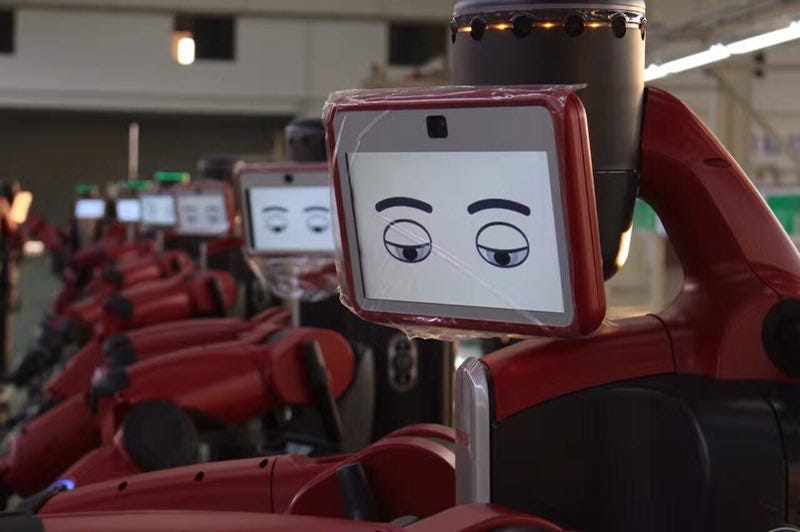
Hats off to the first commercially deployed humanoid at scale - Baxter from Rethink Robotics. According to cofounder Rodney Brooks, “Rethink Robotics, founded in 2008, delivered thousands of upper body Baxter and Sawyer humanoid robots (built in the US) to factories between 2012 and 2018. At the top of this page you can see a whole row of Baxter robots in China. A Sawyer robot that had operated in a factory in Oregon just got shut down in late 2025 with 35,236 hours on its operations clock.”
My prediction for 2026 - please don’t worry about AI trying to kill us for atleast another decade! Artificial stupidity will get us in more trouble than artificial intelligence. I’m talking about things like commercial self-driving car operations unable to handle a power outage. As new systems enter the world, particularly in a race for market share, all sorts of chaotic interactions will surface.
However the master of predictions is Rodney Brooks, who has a strong methodology and avoids the trap of opining on areas (crypto or markets) where he lacks domain knowledge. I particularly appreciate how he frames predictions as understanding the relative trajectory speeds of science, research, product, investment, hype or distribution, and avoiding the trap of assuming that advances in one category will be equally fast across others.
This is my eighth annual update on how my dated predictions from January 1st, 2018 concerning (1) self driving cars, (2) robotics, AI , and machine learning, and (3) human space travel, have held up. I promised then to review them at the start of the year every year until 2050 (right after my 95th birthday), thirty two years in total. The idea was to hold myself accountable for those predictions. How right or wrong was I?
The summary is that my predictions held up pretty well, though overall I was a little too optimistic. That is a little ironic, as I think that many people who read my predictions back on January 1st, 2018 thought that I was very pessimistic compared to the then zeitgeist. I prefer to think of myself as being a realist.
When you look at Brooks’ predictions on self-driving cars, there are two key roadblocks that have made even his ‘pessimistic’ predictions look optimistic. One was whether or not ‘humans in the loop’ count as autonomous operation. According to Brooks, no. However, I’m not sad to keep some human in the loop for safety reasons, as well as reliability.
The other blocker was an overly optimistic view on the willingness of society to invest in infrastructure, even seemingly simple changes like HOV lanes for self-driving vehicles. Adopting a defined car to car communication standard is a complete non-starter without strong federal involvement, which is extremely unlikely.
Re his robotics predictions, while there is progress, according to Brooks “What is easy for humans is still very, very hard for robots.”
Brooks believes that so far no significant improvements in dexterous end effectors have come to market in spite of all the lab and LLM demos. He also doesn’t see reliable home navigation, or the deployment of household robots, or the last 10m of delivery being done by robots any time in the next few years.
Brooks also totally calls bullshit on prognostications of hundreds of millions of humanoids being deployed in the next 5-10 years, citing the rate of all other physical technology deployments in history - something that I’ve been putting into all my talks. When you’re at the leading edge, thousands of robots in the field is truly exciting, but it doesn’t translate into overnight success for another thirty years.
Here are predictions for 2026 to 2035 from Rodney Brooks
1. Quantum Computers. The successful ones will emulate physical systems directly for specialized classes of problems rather than translating conventional general computation into quantum hardware. Think of them as 21st century analog computers. Impact will be on materials and physics computations.
2. Self Driving Cars. In the US the players that will determine whether self driving cars are successful or abandoned are #1 Waymo (Google) and #2 Zoox (Amazon). No one else matters. The key metric will be human intervention rate as that will determine profitability.
3. Humanoid Robots. Deployable dexterity will remain pathetic compared to human hands beyond 2036. Without new types of mechanical systems walking humanoids will remain too unsafe to be in close proximity to real humans.
4. Neural Computation. There will be small and impactful academic forays into neuralish systems that are well beyond the linear threshold systems, developed by 1960, that are the foundation of recent successes. Clear winners will not yet emerge by 2036 but there will be multiple candidates.
5. LLMs. LLMs that can explain which data led to what outputs will be key to non annoying/dangerous/stupid deployments. They will be surrounded by lots of mechanism to keep them boxed in, and those mechanisms, not yet invented for most applications, will be where the arms races occur.
These five predictions are specifically about what will happen in these five fields during the ten years from 2026 through 2035, inclusive. (For a good overview of the whole field of robotics and AI, read all of Brooks’ blog… and the footnotes. See also a summary from Sabine Hauert - the swarm robotics queen.)

Benchmarks and Competitions
And for IEEE Humanoids 2026, which will be held in Silicon Valley at Santa Clara Convention Center, we’ll be working with NIST on benchmarks for Humanoid Robots. It’s been ten years since the DARPA Robotics Challenge which saw humanoid and not-so-humanoid robots tackle human tools and tasks in simulated disaster response scenario. The question now is how much has changed in ten years - can robots tackle human tools and tasks in more ordinary conditions? How recoverable are they? How much is dexterity affected by reach and versatility? And payload!
Benjie Holson laid down five Humanoid Olympiad Events in 2025, designed to push the current state of the art and highlight new capabilities. As Chris Paxton says in “Why is Everyone’s Robot Folding Clothes”, it’s easy to assume that laundry folding (or somersaults and dance moves) indicate a high level of general competence, but in reality it’s something that robots used to be bad at, that current LLMs or VLAs are good at, and that avoid showcasing all the other things that robots are still bad at.
Holson points out the current limitations with these cherrypicked tasks:
No force feedback at the wrists.2 The robot can only ever perform as well as the human teleoperation and we don’t yet have good standard ways of getting force information to the human teleoperator.
Limited finger control.3 It’s hard for the teleoperator (and AI foundation model) to see and control all the robot fingers with more finesse than just open/close.
No sense of touch.4 Human hands are packed absolutely full of sensors. Getting anywhere near that kind of sensing out of robot hands and usable by a human puppeteer is not currently possible.
Medium precision.5 Guessing based on videos I think we’ve got about 1-3 cm precision for tasks.
Holson posted the five events, with three subsections, in September 2025 and already has medallists across the board.
Event 1: Full Body (aka doors)
Bronze Medal: Entering a round-knob push door. (won by IHMC in 18 seconds on 10/26/25)
Silver Medal: Entering a lever-handle self-closing push door.
Gold Medal: Entering a lever-handle self-closing pull door.
Event 2: Laundry
Bronze Medal: Fold an inside-out T-shirt
Silver Medal: Turn a sock inside-out
Gold Medal: Hang a men’s dress-shirt
Event 3: Basic Tool Use
Bronze Medal: Windex and paper towels
Silver Medal: Peanut butter sandwiches
Gold Medal: Use a key
Event 4: Finger tips
Bronze Medal: Roll matched socks.
Silver Medal: Use a dog poop bag
Gold Medal: Peel an orange
Event 5: Slippery when wet
Bronze Medal: Wet a sponge at a sink and wipe a counter-top
Silver Medal: Clean peanut butter off your manipulator
Gold Medal: Use a sponge to wash grease off a pan in a sink
Last week Physical Intelligence has taken a run at 11 of the 15 tasks, with some impressive performances - medals still TBD.

CES Highlights
Carolina Parada from Google DeepMind discusses the future of robotics with Ani Kelkar and a great panel of roboticist and automation experts, including the great Robert Playter Mikell Taylor and Nakul Duggal. Then takes the stage with Alberto Rodriguez to announce a new partnership with Boston Dynamics.
Our Gemini Robotics models give robots the ability to perceive, reason, and take action naturally. By combining our foundational intelligence with their new Atlas® robots, we’ll help scale the impact of robotics safely and efficiently, starting with the automotive industry. The future of robotics is looking very bright! 🦾 🧠 🚀
Learn more at the Boston Dynamics blog → https://lnkd.in/gnCbptW5
Reachy Mini on stage at Jensen Huang’s keynote - 3,000 open source robots shipped to developers in Dec 2025.
Behind that number is a story of open collaboration, fast iteration, and community-driven development. Read the full blog on manufacturing, open hardware, and the community behind Reachy Mini: https://lnkd.in/gUwS-3s2
🎥 From prototype to production
Seeed Studio Founder and CEO Eric Pan and Pollen Robotics CEO Matthieu Lapeyre sat down to reflect on the journey — from early 3D-printed prototypes to mass production, and from voice-first design to solving real acoustic challenges through close collaboration. Watch the conversation here: https://lnkd.in/guDbETPE
🗓️ Mark your calendar! Join us in person or via livestream for a panel discussion at The Foundry @ CES2026.
Robots Among Us: Welcome to the Age of Humanoids
Chack Nalavade | Schaeffler
Deepu Talla | NVIDIA
Pras Velagapudi | Agility Robotics
Moderated by Jesse Orrall of CNET
🕐 Jan 8, 12:30 PT - Fountainebleau Las Vegas
📺 https://live.ces.tech/
Andrea Thomaz, Cofounder at Diligent Robotics, is also speaking on three panels that feel especially timely right now: how intelligence shows up through motion, what “not quite human” humanoids may change about work and daily life, and what we should realistically expect from robots in healthcare.
• Jan 6, 1:00–1:40 PM | LVCC W218 | “Intelligence through Motion: AI Takes Physical Form”
• Jan 7, 10:00–10:40 AM | LVCC W219 | “Not Quite Human: How Humanoids Are Changing Work and Home Life”
• Jan 8, 3:00 PM | Venetian Marcello 4404 | “Will Robots Save Us?”
It’s not all Nvidia or humanoids! AMD debuts a new higher-performing chip at CES.
Silicon Valley Robotics Investor/Startup Database
Are you a startup fundraising atm? Fill out our "For Investors Eyes Only" sheet.
These investors write checks anywhere from angel and seed stage to $5-50 million.
Feedback from the startups - high quality inbound interest from investors.
Feedback from the investors - incredible depth and range of robotics startups.
If you’re an accredited investor and haven’t already signed up for the spreadsheet - Sign up here for great robotics deal flow!
Send me your 2025 progress and 2026 plans for potential inclusion in Robots&Startups.
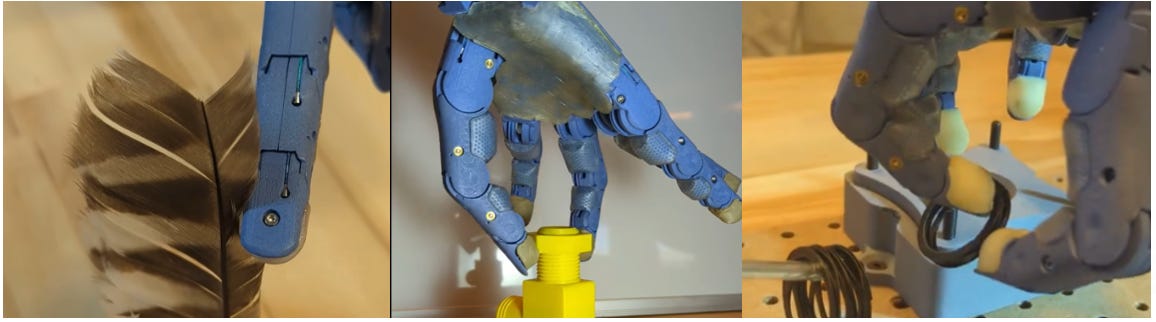
‘Shadowless hand’ from Kyber Labs in NYC:
Wrapping up 2025, we went from small scale prototypes to a finished hand design with some great demos out and early customer traction now. Heading into 2026, we’re excited to focus on scaling the hardware, expanding the team, and getting our hands out into the real world.
To get your hands on one of our hands, please join the waitlist!
Demos:
We posted a feather demo video followed by a screwing a nut demo video and a short assembly demo video that went viral and the feedback has been exciting! We also discussed our technical approach on “Over The Horizon“ podcast with some hand experts.
One particularly entertaining comment we got was that Chinese social media started calling our hand the “shadowless hand” in a kung fu sense as it moves so fast!
We also presented at South Park Commons hardware-only demo night, showing our hand alongside an incredible group of builders in NYC.
Robotics Events
The next SVR Robotics Investment Summit is coming in early 2026 followed by the IEEE Hard Tech Venture Summit in Silicon Valley!
CES - Las Vegas - Jan 6 to 9
NRF - New York - Jan 11 to 13
Bots & Beers - San Francisco or Silicon Valley - Feb 4
Drones and Robotics AI Summit - New York - March 26
European Robotics Forum - Norway - Mar 23 - Mar 27
IEEE Haptics Symposium - Reno - March 29 to Apr 1
ICRA 2026 - Vienna, Austria - Jun 01 - Jun 05
Robotics: Science and Systems - Sydney, Australia - Jul 13 - Jul 16
IROS 2026 - Pittsburgh
IEEE Humanoids 2026 - Silicon Valley - Dec 6-9
The annual IEEE-RAS International Conference on Humanoid Robots is the internationally recognized prime event of the humanoid robotics community. The conference is sponsored by the IEEE Robotics and Automation Society and coordinated by the Technical Committee on Humanoids.
Join the organizing team at Silicon Valley Robotics - bots&beer@svrobo.org


Looking forward to CES and new updates! :)